
Decolonialism Monthly: Climate Refugees
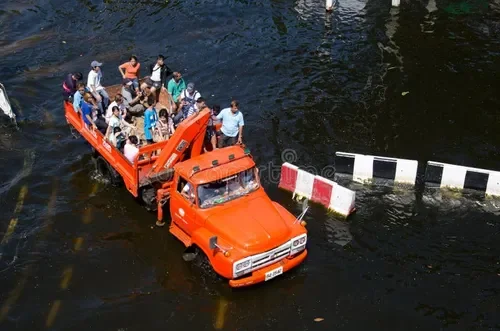
Climate refugees fleeing flooding
Isle de Jean Charles, Louisiana. Cartí Sugtupu, Panama. Nabavatu, Fiji.
What do each of these places have in common? Their populations have all had to completely relocate due to the encroaching and worsening impacts of climate change. There are currently dozens of other communities around the world--including in the United States--planning their relocation. By the year 2050, there could be 1.2 billion people in this position worldwide: climate refugees who must pack up and leave the only home they've ever known because anthropogenic (human-caused) climate change has made their home unlivable.
Capitalism Causes Climate Change
To tackle the subject of climate refugees, we must start first by acknowledging the means by which capitalism systemically causes climate change. Capitalism floods the market with commodities, overproduces instead of meeting people's needs, and promotes speculation and development in industries that do more harm than good, all in the pursuit of profits for an increasingly small group of people. The destruction of forests, the pollution of natural water sources, and the despoiling of land in search of its minerals are all unavoidable consequences of the current ruling class of corporate owners conducting their business unimpeded.
Compounding on this already grave threat to our environment is how the ruling class acts to protect their interests by any means necessary. Emissions released just for maintaining major military activity eclipses that of all but three countries. Israel's ongoing genocide in Gaza has released carbon emissions which exceeds the output of multiple countries combined. And with the United States' war on Iran, attacks on oil and manufacturing infrastructure have released toxic chemicals into the air, water and soil, irreparably damaging the health of Iran and its people, all while pumping more and more greenhouse gasses into the atmosphere that we all share.
These despicable acts of violence, performed solely in service of the material interests of capital, destroy the lives of working class people in totality. The aftermath of a missile strike on industrial workers, doctors, schoolchildren, or any other 'acceptable target' renders the surrounding land and air inhospitable to the community still living on it. Those 'lucky' survivors will only have to deal with debilitating injuries in the present, and chronic illnesses in the long-term, with severe birth defects hanging as a death sentence over the heads of future generations.
All this is not to say that only the most marginalized peoples of the Global South have suffered from anthropogenic climate change. Its effects are felt tangibly right here in the United States of America as well. According to the National Oceanic and Atmospheric Administration, there were 28 weather and climate disasters in 2023, surpassing the previous record of 22 in 2020, of which the damage to infrastructure cost least $92.9 billion. And who, exactly, is footing the bill for these damages? The ruling class of capitalists who control the means of production and extract countless profits?
No. Working class Americans are subjected to paying for the destruction of their homes and environment despite not being primary contributors to the problem. This contradiction between workers and capitalists will only grow larger as more people are forcefully relocated from their homes.
Climate Refugees Abroad & At Home
Natural disasters, worsening due to climate change, are a major contributor to climate-induced relocations. Between 2008 and 2016, an average of 21.5 million people worldwide were displaced from their homes every year due to extreme weather events. By 2022, this number had surged to a record 32.6 million. Other causes of climate migration include droughts and other agricultural pressures, especially in regions that rely on subsistence farming for survival. These environmental conditions also magnify other contributors to displacement, such as poverty and violence. As climate change continues to worsen, these pressures will only grow.
In the United States, there are already an estimated 3 million climate refugees. As of 2017, seventeen coastal communities in the US had chosen to relocate, either partially or fully, further inland. According to the Urban Institute, 3.2 million adults in the U.S. were displaced or evacuated because of environmental disasters in 2022, and a 2024 Forbes survey found that nearly one in three Americans saw climate change as a motivation to move.
Though the United States government has known that the impacts of climate change would force people to relocate, both parties of the capitalist ruling class have chosen to not address this issue in any meaningful way.
In 2015, Obama pledged $2 million to the Denali Commission, an independent federal agency that works to facilitate relocations of communities due to climate change in Alaska. However, that amount "cover[ed] less than 2 percent of the cost to relocate one Alaskan town, estimated at $100 to $200 million." During Trump's first presidency, the federal budget for the Denali Commission was zeroed out. Just before Biden's presidency, the Government Accountability Office (GAO) recommended that the government form a “climate migration pilot program” to help support relocations due to climate change. The GAO reiterated this recommendation during his presidency, but no such program was established.
Cincinnati: Climate Haven?
In recent years, Cincinnati has been touted as a "climate haven." The notion of "climate havens" became popularized in the late 2010s and early 2020s, referring to a city or area that was thought to be more immune to the effects of climate change. However, these cities--Cincinnati included--won't be spared. In fact, many self-declared climate havens in the United States, including Minneapolis, Buffalo, and Ann Arbor, have faced worsening extreme weather events in recent years, and are located in states where temperatures are rising the fastest.
Asheville, NC was once considered a popular climate haven, with the Asheville Citizen Times even reporting in 2023 on worries that the city would become overcrowded from climate-change migration. People had moved there from states like Texas and California to escape wildfires, heat, and droughts. In late 2024, rainfall caused by Hurricane Helene—considerably worsened, as many hurricanes nowadays, due to warming oceans—devastated Asheville, highlighting the flaws with the notion of climate havens.
People may flee from the regions of the world where the worst impacts of climate change will be felt the soonest (and are being felt already), if they are fortunate enough to have the means to do so, but these examples show that it is simply impossible to outrun climate change.
Climate Refugees, Class, and Oppression
Abroad and at home, those who bear the brunt of the worsening impacts of climate change are those who contribute the least to the conditions causing it--an idea referred to as "climate apartheid."
In the US, many of the communities that have had to relocate or are planning relocation--largely in the coastal regions of Louisiana, Florida, Washington, and throughout Alaska--are Indigenous. On a global scale, the global south is getting hit the hardest.
Though it is expected that a vast majority of climate refugees around the world will first seek to relocate within their home country (due to the legal and logistical obstacles faced in moving to a new country), studies have shown that many climate refugees fleeing Central America are doing so--at least in part--due to climate-related reasons. A key factor in family migration from Guatemala to the US in recent years is agricultural stress, largely caused by droughts and other natural disasters which are also worsening due to climate change.
As ICE arrests and deportations continue to ravage metropolitan areas across the country, and with the governments of the entire greater Cincinnati region either directlyaiding in this injustice through 287(g) agreements, or passively allowing it to take place, the idea of Cincinnati as a so-called climate haven is laughable at best. Ignoring the previously-explained flawed reasoning behind the idea of climate havens, even if those areas were truly able to somehow escape climate change, how many of these cities are only interested in being a "haven" to White, wealthy US citizens? For climate refugees coming from beyond US borders, how many of these "havens" would really just be traps?
And of course, there are many people who don't have the means to flee (or who do not want to have to leave their home), nor the means to start their life over. According to the Baker Institute:
Even during the most severe weather events, there are always some people who remain where they are — either because they do not want to move or they are unable to do so. Often it is the elderly who do not move (because of limited physical mobility or lack of financial resources), racial/ethnic minorities, or people with physical or mental disabilities.
The ability to rebuild, for those who do not leave, is similarly impacted by class; homeowners are more likely to receive recovery assistance than those who rent or face housing insecurity. Take the example of Puerto Rico, held as a US colony since 1917. Hurricane Maria swept through the island in 2017 just weeks after Hurricane Irma, devastating already weak infrastructures and worsening human rights conditions:
Before the storms, there were major inadequacies in physical infrastructures, and Puerto Ricans on the island had poorer health outcomes than US residents on the mainland, reflecting the effects of the persistent colonialist policies that scar the health and well-being of the people of Puerto Rico.
The response from the US government in the aftermath of the storms was abysmal. Nearly 3,000 Puerto Ricans--largely poor, elderly, or disabled--died in the months following the storms due to lack of resources and an 11-month long electrical grid blackout, all spurred by a slow and underwhelming aid response from the Trump administration. Though 90% of households in Puerto Rico applied for assistance, by May 2021 (over three years after the hurricanes) it was estimated that 18,000 families were still living under tarps instead of in their homes.
The people who are paying the ultimate price for the impacts of climate change are the poor, working class of the world, not the governments and corporations that propagate climate change in the first place. Under capitalism, there will never exist any meaningful ways to hold the ruling class accountable for their role in the creation of the deteriorating biosphere we find ourselves in; this is all merely an inevitable side effect of their never-ending lust for profit.
Conclusion
Taking this into account, the logical endpoint of capitalism is a world in which everyone, save for an ever-shrinking state protected minority who has consolidated wealth and power, suffers in totality. The destruction and loss of life brought about by natural disasters make clear that we currently lack the structures necessary to combat the current effects of climate change, let alone address the root problems plaguing our planet to begin with.
We are staring down the barrel of an increasingly hostile and uninhabitable environment, and soon there will be nowhere on the planet where you can run to escape its effects. With all other options exhausted, the working peoples of the world, have but one option: stand and fight. This is not an matter that can be ignored, endured, or left in the hands of a government that absolutely does not have your best interests at heart. Your participation in the preservation of your own future, and that of future generations, is not optional.