
The Role of Political Violence in Fighting Capitalism
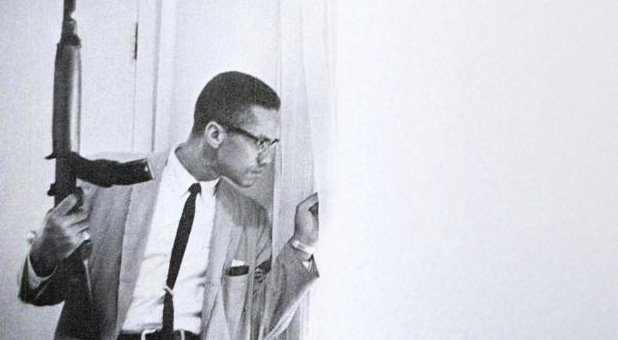
Malcolm X holding an M1 Carbine while looking out the window in March 1964.
"There's no such thing as a bloodless revolution." - Malcolm X
In previous statements, Cincinnati Socialists has advocated the need for revolution rather than reform to end capitalist exploitation and oppression. So have many Marxists before us (e.g. Rosa Luxemburg's Reform or Revolution, Vladimir Lenin's The State and Revolution).
When you understand the need for drastic change, a subsequent question emerges: what is required for an effective revolution? The responses to this question are hotly debated, and often break on the point of whether or not violence is the answer to our struggle.
Before examining this question further, it is important to work with a clear definition of violence. Marxists understand violence as a material, historical force, rooted in class struggle, rather than simply aggression on the scale of individuals. The capitalist ruling class uses systemic and institutionalized violence (e.g. police, military, courts) to suppress and control the working class. Because it necessitates coercion to enforce economic exploitation, capitalism is an inherently violent system.
The capitalist ruling class warps and weaponizes the word "violence." For example, a protester's destruction of property is branded as "violent," while a cop teargassing a crowd is called "keeping the peace." Israel's genocide in Palestine is excused as "a right to self-defense" (despite being the aggressors), but those who challenge this barbarism, whether nonviolently or with force, are the ones labeled terrorists. The US makes accusations against leaders of Cuba and Venezuela of "narcoterrorism," and makes claims of Iran of having nuclear weapons, in order to manufacture public consent to engage in its imperialist violence. While Charlie Kirk's dehumanizing rhetoric about Black and Trans people was a clear example of stochastic terrorism, his individual shooting was the primary focus of the media and prompted bipartisan lamentations of "political violence." When a healthcare CEO allows thousands of preventable deaths to happen because it serves his and the capitalist class's bottom line, that is justified as "business" rather than what it truly is -- social murder.
Capitalism, by its very nature, is sustained by violence. It requires colonialism and imperialism to expand upon itself and sustain its violent functions. It structurally necessitates mass subjugation and labor exploitation. Committing and funding genocide is violent. Destroying the planet for profit is violent-- pillars of capitalism such as the multi-trillion dollar fossil fuel and war industries are the biggest contributors to the climate change that endangers all of us. Prisons and borders are violent -- thousands of people die in US prisons annually and hundreds of people die at the US/Mexico border every year, while the incarceration and immigration detention industry itself is worth billions. Putting the working class's housing, food, and healthcare behind a paywall is violent -- scarcity in this age is artificial by design. These material needs are inaccessible to many of us in the working class only because capitalism requires there to be a class who "owns" and a class who is forced to labor in order to buy back access to our basic needs.
The people uniting to break down these manufactured barriers to meeting our basic human needs, to eliminate these active threats to our very existence, by any means necessary, is simply survival.
“Such is the perversion of 'violence' under imperial and colonial rule: the maintenance of state-sanctioned violence is considered peaceful, while the disruption of those death-making processes is deemed violent.” -Kelly Hayes, Mariame Kaba
Regardless of whether one chooses a nonviolent or violent approach to revolution, we are already inhabiting a highly violent reality -- one marked by regular brutality from the capitalist class.
We have witnessed proof in this country that campaigns of moral suasion and civil disobedience are ineffective strategies on their own. While nonviolent approaches certainly have their place in the revolution, it is fundamentally impossible to dismantle capitalism without the use of strategic political violence.
"In order for non-violence to work, your opponent must have a conscience. The United States has none." -Kwame Ture
So then what course of action lays before us? We stop trying to be heard, and start making ourselves impossible to ignore.
First, let's look at some historical examples of nonviolent resistance:
India's 1919 Jallianwala Bagh Massacre - Protesters gathered to oppose the Rowlatt Act and recent arrests of Indian independence activists. Hundreds of protesters were kettled and shot by British colonial troops. The Rowlatt Act, also known as the "Black Act," gave power to colonial police to arrest any Indian person on the basis of mere suspicion. This should sound familiar to the working class as the US's recent invocation of the Alien Enemies Act, the Patriot Act, stop-and-frisk policing, and ICE entering homes on the basis of "reasonable suspicion."
India's 1930 Salt March - A 24-day nonviolent civil disobedience march and tax resistance led by Gandhi to protest the British salt monopoly. Gandhi and 60,000 protesters were arrested. Hundreds of nonviolent protesters were brutally beaten by the colonial police. Protesters were not beaten and arrested because they posed a threat to anyone's safety, but because they posed a threat to capital. While protesters were employing the common pacifist tactic of simply absorbing any violence they received -- even refraining from covering their heads from the blows of the colonial police -- the colonial police were emboldened to beat protesters because they were aware they wouldn't fight back.
1961 Attacks on Freedom Riders in Anniston and Birmingham Alabama - Although the supreme court ruled segregation on interstate public transport unconstitutional, southern Jim Crow states continued enforcing it. An interracial group of Freedom Riders organized peaceful bus rides to protest this. The KKK and the National States' Rights Party (a white supremacist political party) violently attacked the Freedom Riders while the police turned a blind eye. In a clandestine meeting with the Alabama Knights (a faction of the KKK), white supremacist Birmingham police sergeant Tom Cook said, "We're gonna allow you fifteen minutes....You can beat 'em, bomb 'em, maim 'em, kill 'em. I don't give a shit. There will be absolutely no arrests. You can assure every Klansman in the country that no one will be arrested in Alabama for that fifteen minutes." Cook also shared information with the Klan on the Freedom Riders' plan -- including their exact route-- that Birmingham PD had received from the FBI. FBI director J. Edgar Hoover had prior knowledge of plans to attack the Freedom Riders, but forwarded only limited information to the Attorney General or DOJ. No one within the civil rights movement, including the Freedom Riders, was ever warned.
1961 Albany Movement - A nonviolent desegregation and voter's rights coalition in Albany, Georgia, who worked alongside Martin Luther King Jr. and the Southern Christian Leadership Conference. Over 2,000 nonviolent protesters were arrested over the course of this campaign. Albany police Chief Pritchett studied the movement's nonviolent tactics, and ensured that these particular arrests did not involve enough police brutality to attract publicity, and dispersed the arrested protesters to multiple county jails across southwest Georgia in order to thwart the campaign's attempt to clog Albany's jail.
"Chief Pritchett proved that [nonviolence] fails if one cannot provoke the opponent into their worst impulses. You cannot delegitimize an opponent who seems reasonable to the dominant public." - Too Black
Martin Luther King Jr., a socialist, advocated for nonviolence throughout the civil rights movement, but was assassinated in 1968 when he started critiquing and challenging capitalism through the organizing of the poor man's campaign.
While there are countless examples through history, both internationally and nationally, of nonviolence being met with violence from the ruling class, it is not just something that happened "back then" or "over there." We continue to see more (and more, and more) of the same systemic violence today in Cincinnati.
For example, Cincinnati's response to George Floyd's 2020 murder by a police officer mirrors the Albany Movement as so many protesters were arrested that the jail was over-crowded. However, instead of being sent to other jails, some arrestees were simply left outside overnight in the cold! All across the country Black Lives Matter movements protesting police brutality were met with militarized police initiating and escalating violence.
There are nearly 200 instances so far in 2026 of police killing working class people in the US, with an unsurprisingly disproportionate amount of them being Black and Brown. This is no coincidence. White supremacy and capitalism are codependent on each other -- racial hierarchies were created to sustain and justify violent economic extraction. For example: European colonizers justified their genocide of people indigenous to Turtle Island by branding them "savages”; the American capitalist economy was built on the backs of kidnapped and enslaved Africans; and today (predominantly racialized) imprisoned laborers make pennies on the hour to generate over 11 billion dollars in goods and services annually.
Locally we have one of the most expensive, most violent, and least accountable police departments in the nation. Ryan Hinton, Timothy Thomas, and Sam DuBose are only a few examples of those who have tragically joined the list of those whose lives were brutally cut short by CPD.
Throughout the US, we see ICE murdering nonviolent people with impunity. Dozens have been killed by ICE in the last decade, and no agents have seen criminal charges, as they are largely protected by having federal immunity. Renee Good was unarmed when she was shot to death by an ICE agent while legally observing him. Homeland Security Secretary Kristi Noem called Good a "domestic terrorist." The murders of Renee Good and Alex Pretti, a nurse who was shot while filming ICE and helping a fellow protestor, highlight the fact that no matter how close a person's proximity is to whiteness, or how closely a person otherwise fits traditional conventions of "respectability," they will be swiftly and violently punished for challenging white supremacy and capital. It does not matter whether you are documented, employed, a parent, sober, or have a criminal record. This is fundamentally how governance in capitalism operates, violence of the rule to smother the rage of the oppressed.
Cincinnati's own Imam Soliman was subjected to suppression from the ruling class via ICE, despite his activity being nonviolent. First, he was tortured in Egypt for his journalism during Arab Spring. He was then granted asylum in the US, but subsequently had his protections revoked without meaningful justification. He was detained by ICE while at an immigration check-in, despite his compliance with immigration status requirements.
Movements like No Kings are ultimately toothless because organizers like 50501 platform ruling-class capitalist politicians while encouraging protestors to be docile no matter what. Beware of those who will co-opt and redirect your righteous rage.
While nonviolent action serves an important function in creating change, violent resistance will be an inevitable and crucial aspect. In his essay Nonviolence Is Violence Too: Somebody's Gotta Die, author and poet Too Black reframes nonviolence to sacrificial violence, stating, "when applying nonviolence as a tactic—utilizing the brutality of an opponent against them to extract concessions tied to strategic objectives—a conscience is not required. The primary goal is to exploit their heartlessness to gain support from people who may otherwise be indifferent or afraid. Upon receiving this support, one may galvanize it to momentarily force the opponent to change their behavior out of necessity, not conscience." To demand the empire cease its relentless violence is to demand the ruling class surrender their existence as the ruling class.
Violent resistance has historically been an indispensable catalyst for change in any case that liberation has been won. In the Haitian Revolution, enslaved Africans organized and revolted alongside allies to defeat the British and French colonial armies and establish Haitian sovereignty. These revolutionaries were not passive victims, but rather people who changed their conditions through collective action.
Consider what may have happened (or what may have not) had Black slaves in the nineteenth century not broken their tools, torched plantations, and killed the Southern slaveowners that held them in chains. The abolition of chattel slavery in this country was the result of generations of African captives resisting their bondage by any means necessary, followed by the bloodiest war in American history.
Some argue that willingness to use violence in the struggle for liberation makes us no better than our violent oppressors. However, it is a remiss oversimplification to make no distinction between those who use violence to maintain their exploitative power over others, and those who are willing to engage in violence strategically for the liberation of all.
"Political power grows out of the barrel of a gun" - Mao Zedong
Many would agree that if a dangerous intruder were to break into their homes, they reserve the right to defend themselves and their families by any means necessary -- including using violence. The capitalist ruling class and those who protect it are a threat to the rest of us, the working class. Why would we not collectively reserve the right to defend ourselves by any means necessary? Regardless of one's personal moral stance on the use of violence, organized and strategic force is what is ultimately effective in changing our conditions.
"We want freedom by any means necessary. We want justice by any means necessary. We want equality by any means necessary." - Malcolm X
We are not advocating violence for violence's sake, nor individual acts of aggression. Our resistance must be disciplined and collective. The working class is entitled to maintain sovereignty over ourselves, and resist our oppressors by means of force. We must protect ourselves from those who would do us harm, such as capitalists and those who fight to uphold the oppressive structures we seek to dismantle. For this reason, we stand in solidarity with the armed working class of Venezuela, and those across the world who will fight with force for their liberation and the liberation of all.
“At the risk of seeming ridiculous, let me say that the true revolutionary is guided by a great feeling of love. It is impossible to think of a genuine revolutionary lacking this quality.” - Che Guevara
Every one of us has a place in the revolution. And while not everyone's place in the revolution will involve taking up arms, we must reject liberal pacifism and understand the necessity of strategic political violence in effectively ending capitalism. We cannot equate the violence of the oppressors with the righteous, liberatory struggle of the oppressed.